


Positive Deviance - The people who make organisations better
Updated: Mar 17
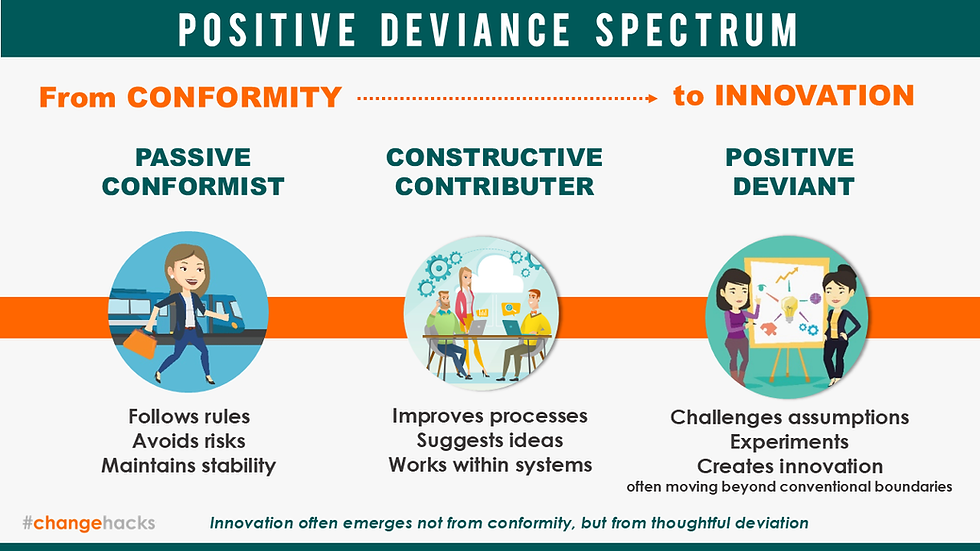
In many organisations there is an unspoken expectation that people will fit in.
Fit the culture. Fit the way things are done. Fit in with the unwritten rules.
But sometimes the people who bring the greatest value are the ones who don’t quite fit.
These individuals are often known as positive deviants. They drive innovation which emerges from thoughtful deviation, not conformity.
The term positive deviance was popularised by researchers such as Richard Pascale, Jerry Sternin, and Monique Sternin. It describes individuals or groups who succeed in the same environment and constraints as everyone else, but achieve better results because they think or behave differently.
They are not rule breakers for the sake of rebellion. They are people who see possibilities that others overlook.
And yet, positive deviants are often misunderstood.
Why they are often misunderstood
Positive deviants rarely follow the established script. That alone can make them uncomfortable for organisations that value predictability, conformity and control.
They may be labelled as:
Difficult - not being a team player, over-complicating things
Non-conformist - going outside the process
Challenging authority
‘Not a culture fit’
But what is often interpreted as resistance is frequently curiosity, critical thinking, or a refusal to accept inefficient norms.
Many organisations unintentionally suppress these voices because they prioritise harmony over constructive challenge.
The irony is that the very behaviours that make positive deviants uncomfortable within organisations are often the same behaviours that lead to innovation and improvement.

The value positive deviants bring
When organisations learn to recognise and support positive deviants, they gain access to powerful sources of improvement.
Positive deviants tend to:
See problems differently They question assumptions and look at problems from angles others may not consider.
Experiment within constraints Unlike external consultants or theoretical frameworks, positive deviants operate within the same constraints as everyone else, making their solutions practical and credible.
Challenge groupthink They help prevent organisations from becoming trapped in herd thinking or comfortable inefficiencies.
Spark innovation Their curiosity and willingness to try new approaches can lead to breakthrough ideas.
Influence others through example Because they are embedded within the organisation, their behaviours can spread organically when others see their success.
The risk of ‘culture fit’
Many organisations recruit heavily for ‘culture fit’. While cultural alignment matters, it can also unintentionally create homogeneity of thinking.
When everyone thinks the same way, organisations may feel cohesive, but they often become less adaptive.
Positive deviants bring cognitive diversity, which is essential for innovation and resilience.
In other words, great organisations don’t just recruit people who fit the culture, they recruit people who expand it.
How organisations can encourage positive deviance
Encouraging positive deviance does not mean encouraging chaos or ignoring standards. It means creating space for thoughtful challenge and experimentation.
Leaders can support this by:
1. Rewarding curiosity
Encourage questions like ‘Why do we do it this way?’ rather than shutting them down.
2. Protecting constructive dissent
Create a climate of psychological safety so people can challenge ideas without fear of being labelled difficult.
3. Looking for internal outliers
When a team or individual is achiving better results, ask what they are doing differently.
4. Celebrating learning, not just compliance
Recognise experimentation and thoughtful problem solving.
5. Recruiting for mindset Look for the personal qualities of adaptability, curiosity, and openness to learning rather than simply seeking people who fit existing norms. When organisations place too much emphasis on culture fit, people who are brave positive deviants are unintentionally filtered out. Yet they are often the catalysts for valuable improvement.
Leveraging their power
Positive deviants often operate quietly at the edges of organisations.
They may not always be the loudest voices in the room. They may not always follow the expected path.
But they frequently see possibilities before others do.
Organisations that learn to recognise and support these individuals gain something incredibly valuable: the ability to evolve from within.
And in a world that is constantly changing, that may be one of the most powerful capabilities an organisation can develop.
You might also want to check out my blog post on Don't recruit for culture fit - recruit for mindset.


Comments